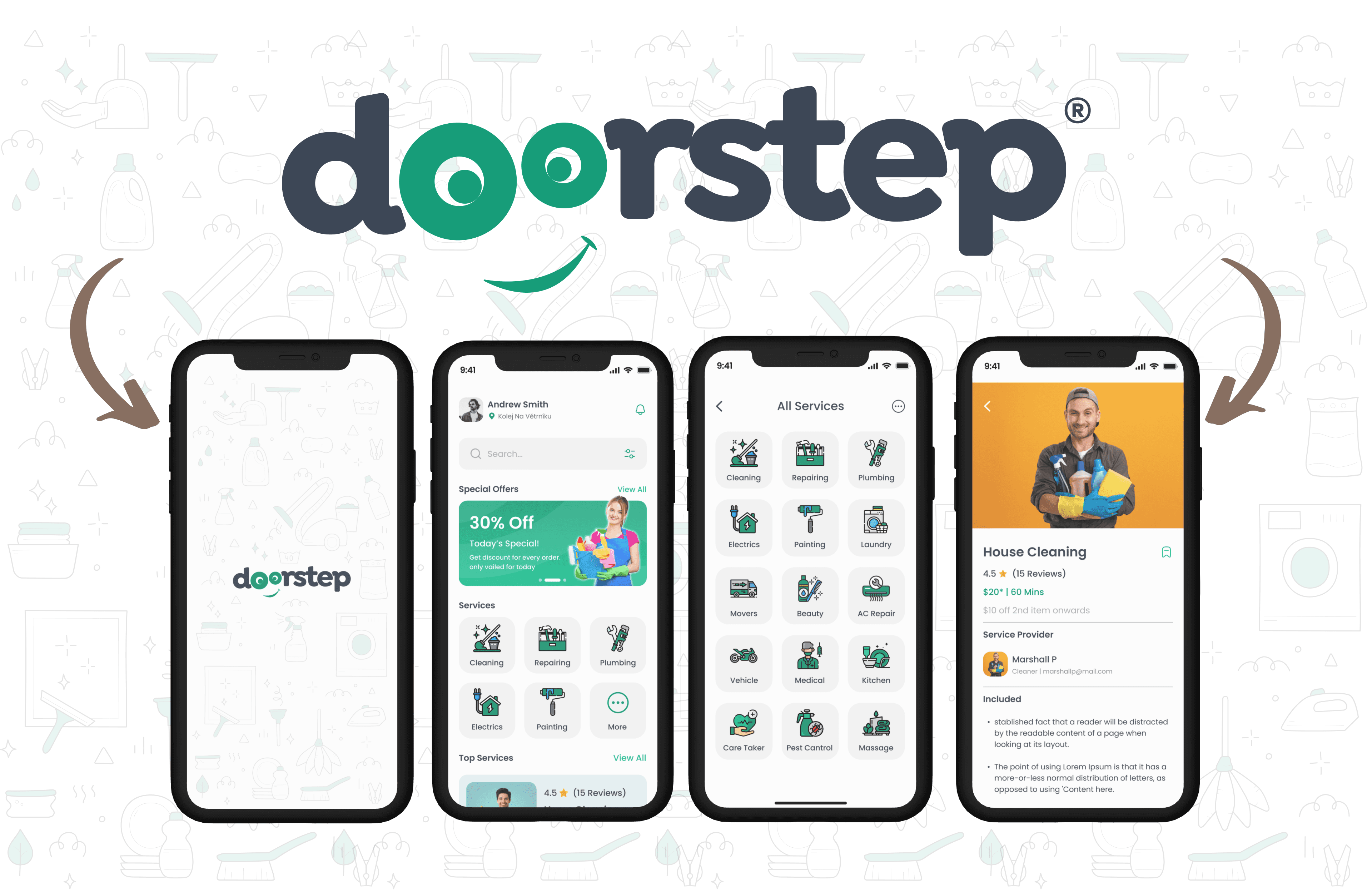
Professional Home Services App
Sector
Quick-Commerce, Home Services, Real-Estate
My Role
Entire product design, UX Research, UX Design, UI Design, Prototyping
Tools
Figma, Figjam, Illustrator
Project Name
Doorstep: Professional Home Services, Just a Tap Away!
Project Duration
2 Weeks
Overview
Doorstep is an on-demand home services mobile app that connects users with verified professionals for cleaning, repair, plumbing, painting, moving, and other household needs — all from one platform. The goal was to design a seamless, trustworthy, and easy-to-use experience that simplifies how people book and manage home services.
Purpose of the App
To create a user-centered platform that bridges the gap between homeowners and reliable service providers by offering transparent pricing, verified professionals, real-time tracking, and secure payments — bringing convenience and confidence to everyday home maintenance.
Problem Statement
Homeowners often struggle to find reliable service providers quickly, facing inconsistent quality, hidden charges, and poor communication. Service professionals, on the other hand, lack steady job opportunities and reliable payment systems. The challenge was to design a digital solution that builds trust, saves time, and simplifies service management for both sides.
Design Process
Meeting With Stakeholders
Secondary Research
Primary Research
Building Personas
Solutions
User Flow/ IA
Low Fidelity wireframes
Building Design System
High Fidelity Wireframes
Prototyping
User Testing
Secondary Research Overview
To gain a deeper understanding of the on-demand home services market, I conducted comprehensive secondary research using credible sources such as industry reports, competitor platforms, and market analyses. The goal was to uncover key pain points faced by both service seekers (users) and service providers, and to identify opportunities for improving convenience, reliability, and trust in this sector.
Research Focus: The study explored challenges in booking home services, professional reliability, pricing transparency, and user experience gaps across existing platforms.
Search Strategy: Keywords such as “on-demand home services app,” “user trust in service platforms,” “gig economy challenges,” and “home maintenance app UX trends” guided the research.
Source Evaluation: Each source was critically reviewed for relevance and credibility to ensure insights aligned with user expectations and current market behavior.
Key Findings: Research revealed common issues including trust deficits, inconsistent service quality, unclear pricing, and fragmented user experiences across most platforms.
This research established a strong foundation for defining user needs, evaluating market gaps, and shaping a design solution that’s intuitive, transparent, and user-focused.
Goals for Secondary Research:
Understand the market context and current challenges in home service booking.
Identify potential opportunities for innovation and differentiation.
Analyze competitor strengths and weaknesses.
Assess stakeholder needs for both users and service providers.
Key Findings from Secondary Research
User Challenges: Difficulty finding verified professionals, inconsistent pricing, lack of real-time updates, and trust issues.
Service Provider Challenges: Limited visibility, inconsistent job opportunities, and unreliable payment systems.
Competitor Gaps: Existing platforms often lack transparency, personalization, and post-service support.
Opportunities: A centralized, transparent platform with verified providers, upfront pricing, and easy communication.
Best Practices: Incorporating ratings, real-time tracking, micro-interactions, and AI-based service recommendations can elevate the user experience and build long-term trust.
Competitor Analysis
To understand the current market and user expectations, I analyzed two leading players in the Indian home services industry: Urban Company (formerly UrbanClap) and Housejoy. Both platforms offer a range of at-home services, including cleaning, repair, beauty, and maintenance.
Key Findings from Secondary Research
Urban Company
Housejoy
Urban Company
Urban Company is India’s largest on-demand home services platform, connecting users with trained and verified professionals for a variety of tasks such as cleaning, repair, grooming, and fitness.
Strengths:
Strong brand trust and verified professional network.
Seamless user experience with real-time tracking and service customization.
Transparent pricing and secure payment integration.
Strong focus on safety standards and customer satisfaction.
Weaknesses:
High service costs compared to local alternatives.
Limited personalization beyond preset categories.
Service availability restricted to major metro cities.
Housejoy
Housejoy provides a wide range of household and renovation services through its app and website, targeting convenience and affordability for daily home needs.
Strengths:
Offers a broad service range, from cleaning to construction.
Affordable pricing structure for regular maintenance services.
Focus on quick booking and same-day service availability.
Regular promotional offers to attract repeat users.
Weaknesses:
Inconsistent service quality and user feedback mechanisms.
Outdated interface and design, impacting user trust and engagement.
Lack of real-time tracking or progress updates.
Limited post-service support and professional accountability.
Primary Research
After thoroughly analyzing competitors and understanding market trends, we gained valuable insights into the challenges faced by users and service providers in the home services industry. However, to design a truly user-centered solution, it was important to validate these assumptions through direct user interaction.
Based on our secondary research, we identified a lack of clarity regarding specific user pain points during booking, trust perception, and post-service feedback experiences. Therefore, we conducted primary research in the form of user interviews and short surveys with homeowners and service professionals to gather firsthand insights about their needs, frustrations, and expectations.
User persona
Based on the insights gathered from both secondary and primary research, we developed user personas representing the two primary groups interacting with the platform — homeowners and service providers. These personas helped clarify user goals, frustrations, and expectations throughout the booking and service journey.
The personas were created to guide design decisions and ensure that every feature addressed real user needs, from discovering services to managing bookings and post-service feedback.
1. Homeowner User Persona

Name: Sarah Johnson | Age: 35
Occupation: Marketing Manager
Background:
Lives in a suburban home with her family.
Values convenience and quality in home services.
Goals:
Easily book reliable home services like cleaning and repairs.
Manage service appointments efficiently.
Ensure the safety and comfort of her family at home.
Challenges:
Limited time due to demanding work schedule.
Concerns about the reliability of service providers.
Technology Use:
Uses a smartphone for managing daily tasks & appointments.
Comfortable with mobile apps and online payments.
Needs from Doorstep:
User-friendly interface for quick service booking.
Assurance of vetted and trusted service providers.
Notifications and updates on service status.
Service Provider User Persona

Name: John Doe | Age: 28 | Occupation: Freelance Plumber
Background:
Has been working independently for 5 years.
Values flexibility and steady income from service jobs.
Goals:
Find consistent job opportunities and clients.
Build a positive reputation for quality service.
Improve efficiency in managing service appointments.
Challenges:
Inconsistent workload and client base.
Need for reliable payment and client communication.
Technology Use:
Uses a smartphone for managing appointments and client communications.
Comfortable with mobile apps and digital payment systems.
Needs from Doorstep:
Easy access to job requests and client details.
Clear communication tools with clients.
Reliable payment processing and scheduling features.
Empathy Mapping
After defining the user personas, we created empathy maps to better understand users’ thoughts, feelings, and motivations throughout their interaction with the platform. This exercise helped uncover emotional triggers and pain points that influence user decisions.
The empathy maps were instrumental in identifying what users think, feel, say, and do, allowing us to design more empathetic, goal-oriented experiences that align with their real-world needs.
Sarah Johnson
Says:
"I struggle to find reliable home service providers."
"I need services that fit into my busy schedule."
"I want to ensure my family's safety and comfort at home."
Does:
Researches online reviews and recommendations for service providers.
Seeks scheduling options that are flexible and convenient.
Prioritizes services that offer transparent pricing & reliable communication.
Thinks:
Concerned about the quality and reliability of service providers.
Wants convenient and efficient solutions for home maintenance.
Values time-saving options that don't compromise on quality.
Feels:
Frustrated with juggling work and household responsibilities.
Anxious about trusting unfamiliar service providers.
Relieved when she finds dependable and trustworthy services.
Pain Points:
Limited time to manage household tasks due to a demanding job.
Stress from managing multiple responsibilities.
Concerns about the safety and well-being of her family.
Gains:
Peace of mind from knowing her home is well-maintained.
Satisfaction from finding reliable services that simplify her life.
More time to spend with her family and pursue personal interests.
John Doe
Says:
"I need a steady stream of job opportunities."
"I want to build a positive reputation in the industry."
"I value clear communication with my clients."
Does:
Responds promptly to job requests and client inquiries.
Maintains a professional online presence to attract new clients.
Invests in tools and technology that improve his efficiency & service quality.
Thinks:
Thinks about ways to attract more clients and grow his business.
Considers the benefits of using technology to streamline his work pro.
Values opportunities for professional growth and skill enhancement.
Feels:
Motivated to provide excellent service and satisfy his clients.
Frustrated with inconsistent workloads and payment delays.
Confident when he receives positive feedback and referrals.
Pain Points:
Uncertainty about job availability and financial stability.
Challenges in managing client expectations and handling disputes.
Stress from balancing work commitments and personal life.
Gains:
Satisfaction from delivering high-quality service and earning client trust.
Opportunities for steady work and income growth.
Recognition and referrals that enhance his reputation in the industry.
Solution Based on Secondary and Primary Research
By synthesizing insights from both secondary and primary research, we proposed a dual-platform solution designed to address the distinct needs of homeowners and service providers, ensuring a seamless and trustworthy home service experience.
For Homeowners
We designed a mobile app that simplifies how users discover, book, and manage home services:
Easy Service Discovery: Users can browse verified professionals through categorized listings and smart search filters.
Transparent Pricing: Clear cost breakdowns before booking to avoid hidden charges.
Real-Time Tracking: Live updates on professional arrival, service progress, and completion status.
Secure Payments: Integrated payment gateway with digital receipts and refund support.
Post-Service Feedback: Option to rate and review service quality, helping maintain platform trust.
For Service Providers
We developed a partner-facing app that helps professionals manage jobs, track earnings, and grow their business:
Profile & Verification: Providers can create verified profiles showcasing expertise and certifications.
Job Management: View bookings, update service status, and manage work schedules easily.
Earnings Dashboard: Track completed jobs, payments, and monthly income summaries.
Customer Interaction: In-app chat and notifications to communicate directly with clients.
Performance Insights: Analytics on ratings, service history, and improvement opportunities.
The following design process focuses primarily on the user (homeowner) side of the app, as that’s where my main design involvement and testing were centered.
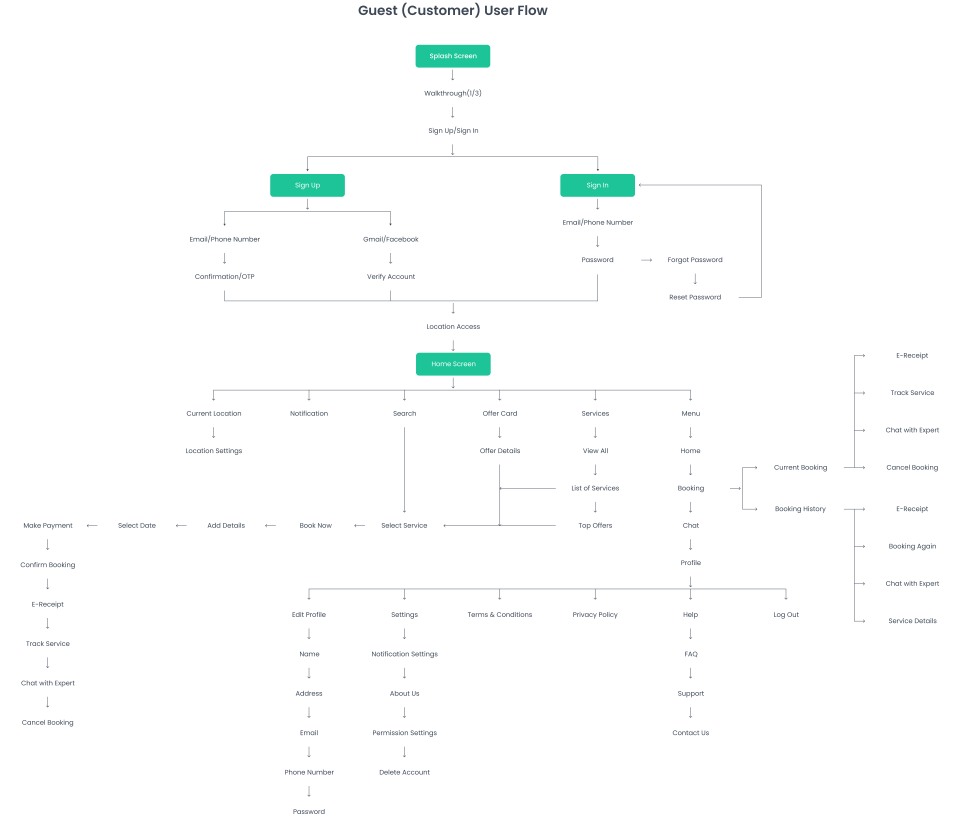
User flow/ Information Architecture (IA)
Building on the insights gathered from the user personas, I designed a user flow that outlines the key steps and interactions a homeowner would take to book, manage, and review a service. This structure ensures a smooth and intuitive experience, aligning with user goals and expectations at every stage of the service journey.
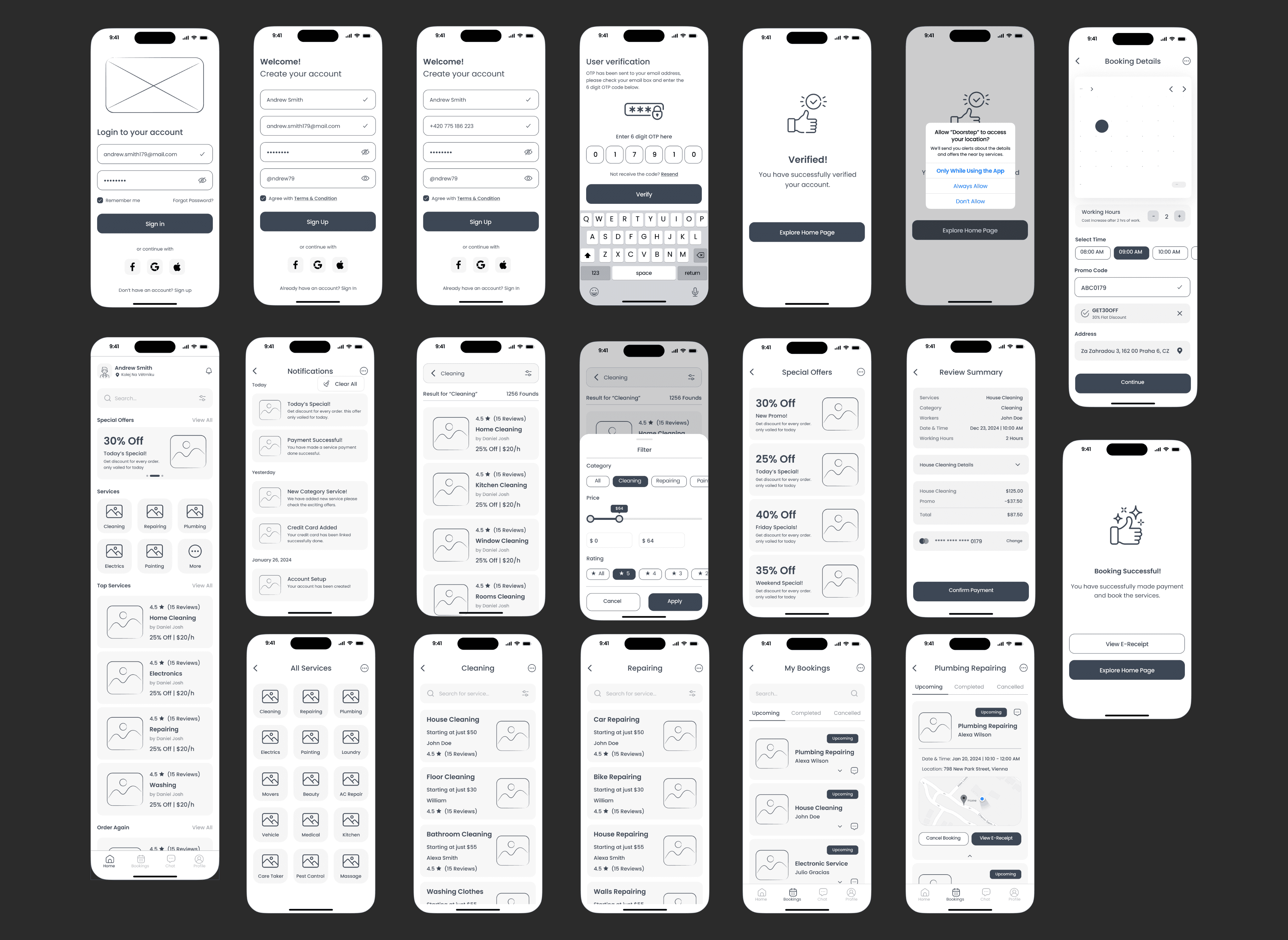
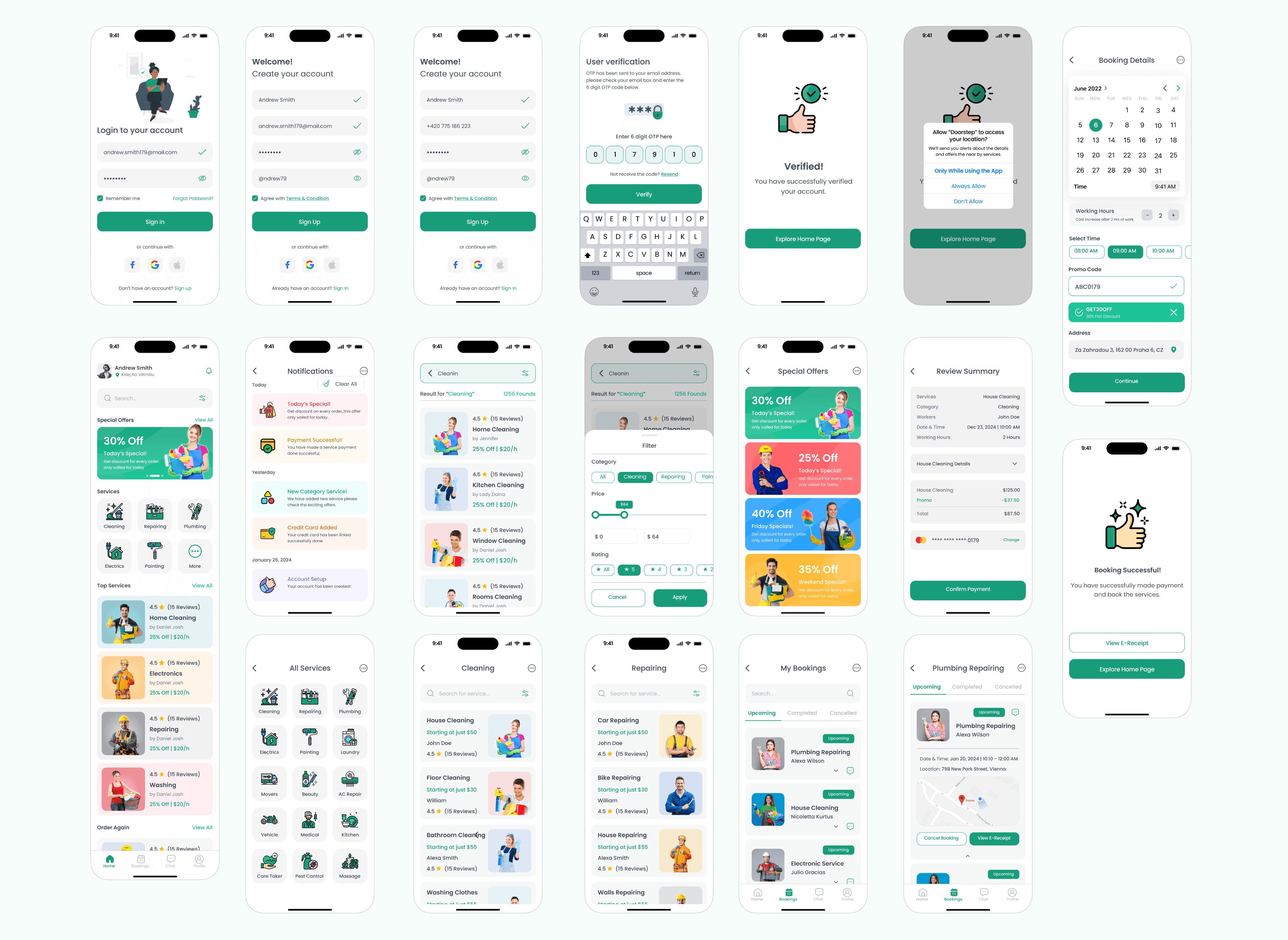
Medium Fidelity Wireframes
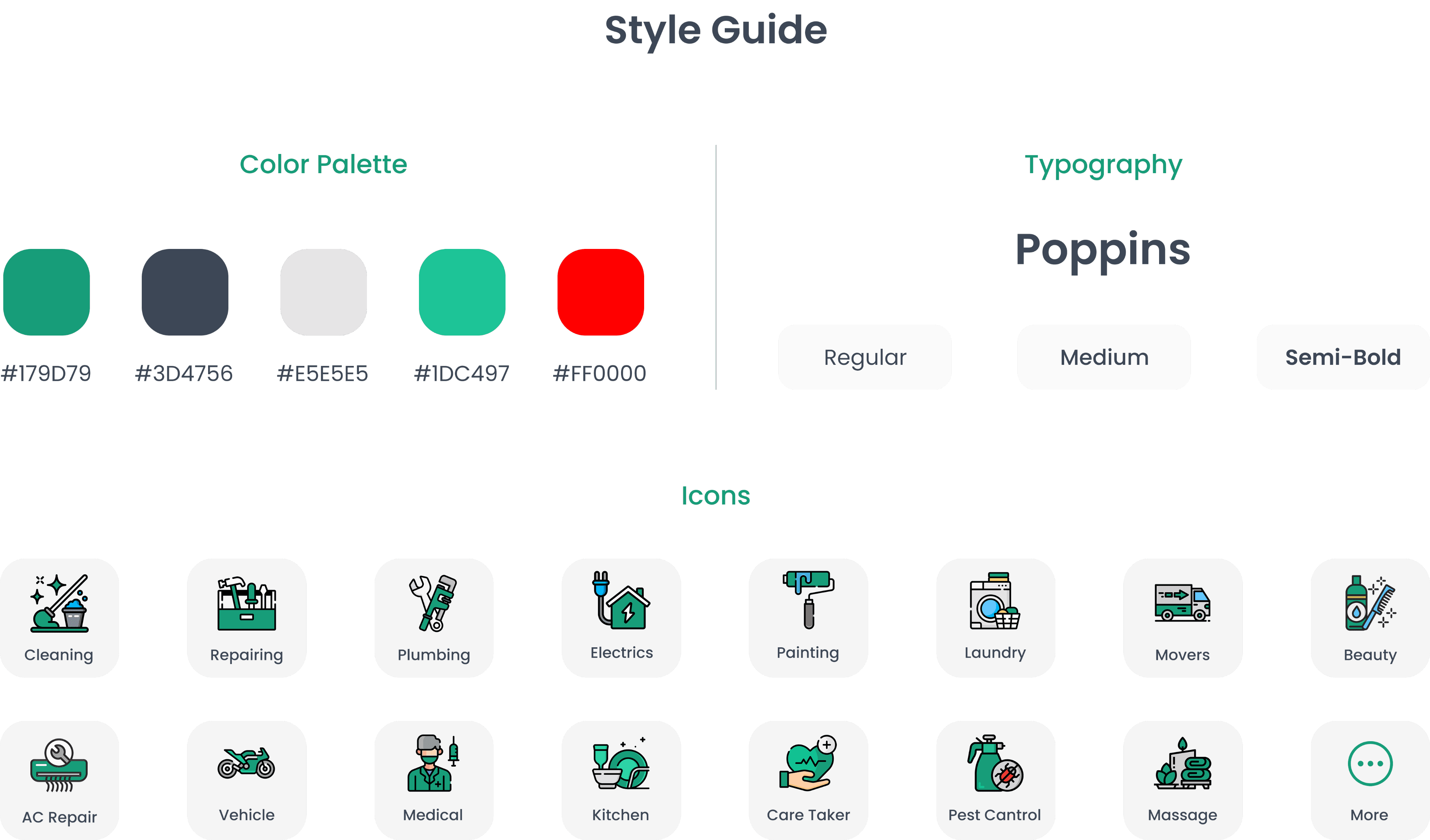
Building style guide
Conclusion
The Doorstep project strengthened my understanding of designing for multi-user ecosystems, where both homeowners and service providers have distinct yet interconnected goals. Through user-centered research and iterative design, I was able to create an experience that balances trust, transparency, and convenience.
This project also reinforced the importance of aligning design with real-world behaviors — ensuring that digital solutions not only look good but genuinely simplify everyday life.
If there was more time available…
If I had more time, I would have focused on conducting in-depth usability testing with both homeowners and service providers to refine edge cases and enhance task efficiency. Additionally, I’d explore AI-driven service matching and real-time progress tracking features to make the platform more adaptive and personalized for users.
Learnings
Gained deeper understanding of designing multi-role platforms that balance both homeowner and service provider needs.
Enhanced skills in creating consistent design systems across web and mobile interfaces.
Learned the importance of clear communication and coordination between designers, developers, and stakeholders for smoother delivery.
Improved in defining user flows and information architecture for complex, data-heavy applications.
Strengthened ability to adapt UX processes to meet business goals while maintaining user-centered design.
Challenges Solved
Simplified document and issue management by creating an intuitive dashboard and reporting system.
Improved communication flow between homeowners and service providers through integrated messaging.
Ensured design consistency across multiple devices using a unified component-based design system.
Reduced onboarding friction by designing clear navigation and step-by-step guidance for users.
Enhanced usability and transparency in tracking property-related activities and compliance documents.
Recent works


" height="26.158567070103608px" id="lXrpap7NW" transform="translate(3.689 2.918)" width="26.15855065841994px"/></svg>)
" height="26.8125px" id="X0_5DBdh7" transform="translate(4.125 1.563)" width="24.75px"/></svg>)
Let's connect
Feel free to reach out for collaborations or just to say hello! 🤘
Email:
Kunalshankar77@gmail.com
Phone:
+91-7980072892
Follow:
" height="24px" id="AEnhlwlv0" transform="translate(4.493 4)" width="23.99999px"/></svg>)
" height="6.962585221328528px" id="XAclm3fFB" transform="translate(10.299 12.484)" width="4.245814666434837px"/><path d="M 19.319 12.545 C 19.251 12.385 19.148 12.242 19.017 12.127 C 18.886 12.012 18.732 11.928 18.564 11.881 C 18.229 11.79 17.879 11.77 17.536 11.824 C 17.193 11.878 16.865 12.005 16.575 12.195 C 16.285 12.487 16.098 12.866 16.041 13.273 C 16.041 13.416 16.041 13.443 16.211 13.443 L 19.371 13.443 C 19.527 13.443 19.527 13.443 19.513 13.247 C 19.498 13.002 19.433 12.763 19.319 12.545 Z M 19.319 12.545 C 19.251 12.385 19.146 12.242 19.016 12.127 C 18.885 12.012 18.732 11.928 18.564 11.881 C 18.229 11.79 17.879 11.77 17.536 11.824 C 17.193 11.878 16.865 12.005 16.575 12.195 C 16.285 12.487 16.097 12.866 16.04 13.273 C 16.04 13.416 16.04 13.443 16.209 13.443 L 19.371 13.443 C 19.527 13.443 19.527 13.443 19.513 13.247 C 19.498 13.002 19.43 12.763 19.316 12.545 M 20.8 0 L 5.2 0 C 3.821 0 2.498 0.548 1.523 1.523 C 0.548 2.498 0 3.821 0 5.2 L 0 20.8 C 0 22.179 0.548 23.502 1.523 24.477 C 2.498 25.452 3.821 26 5.2 26 L 20.8 26 C 22.179 26 23.502 25.452 24.477 24.477 C 25.452 23.502 26 22.179 26 20.8 L 26 5.2 C 26 3.821 25.452 2.498 24.477 1.523 C 23.502 0.548 22.179 0 20.8 0 Z M 15.704 8.28 C 15.704 8.177 15.704 8.137 15.821 8.137 L 20.033 8.137 L 20.033 9.231 C 20.033 9.231 20.037 9.308 19.968 9.308 L 15.887 9.308 C 15.704 9.308 15.704 9.308 15.704 9.127 Z M 11.804 17.836 C 10.204 18.707 7.515 18.356 4.329 18.356 L 4.329 7.579 L 9.412 7.579 C 10.712 7.579 12.259 7.904 12.675 9.281 C 12.891 9.883 12.878 10.543 12.638 11.135 C 12.398 11.728 11.948 12.211 11.375 12.493 C 11.903 12.689 12.365 13.032 12.705 13.482 C 13.045 13.932 13.249 14.469 13.292 15.032 C 13.336 15.594 13.218 16.156 12.952 16.653 C 12.686 17.15 12.283 17.561 11.791 17.836 Z M 21.489 14.768 L 16.289 14.768 C 16.147 14.768 16.016 14.845 16.041 15.028 C 16.197 15.795 16.548 16.601 17.343 16.719 C 17.762 16.844 18.212 16.824 18.619 16.664 C 19.026 16.504 19.369 16.212 19.591 15.835 C 19.591 15.835 19.656 15.756 19.695 15.756 L 21.385 15.756 C 21.385 15.756 21.489 15.756 21.463 15.847 C 21.284 16.352 21.021 16.822 20.683 17.237 C 20.231 17.669 19.686 17.991 19.089 18.177 C 18.493 18.364 17.862 18.411 17.244 18.314 C 16.627 18.218 16.04 17.98 15.53 17.62 C 15.019 17.259 14.598 16.786 14.3 16.237 C 14.117 15.871 14.002 15.474 13.963 15.067 C 13.731 14.042 13.908 12.968 14.457 12.072 C 15.005 11.176 15.882 10.53 16.9 10.271 C 19.851 9.633 21.723 11.661 21.723 14.521 C 21.727 14.555 21.724 14.589 21.713 14.621 C 21.702 14.653 21.684 14.682 21.66 14.705 C 21.636 14.729 21.607 14.747 21.575 14.758 C 21.543 14.769 21.509 14.772 21.476 14.768 Z M 18.577 11.881 C 18.243 11.789 17.892 11.769 17.549 11.825 C 17.207 11.879 16.9 11.944 16.588 12.195 C 16.276 12.444 16.111 12.865 16.055 13.273 C 16.055 13.416 16.055 13.443 16.224 13.443 L 19.371 13.443 C 19.527 13.443 19.527 13.443 19.513 13.247 C 19.498 13.002 19.433 12.763 19.319 12.545 C 19.251 12.385 19.148 12.242 19.017 12.127 C 18.886 12.012 18.732 11.928 18.564 11.881 Z" fill="rgb(0, 0, 0)" height="25.99997px" id="tZJP9vVhA" transform="translate(3.827 3.332)" width="26.000049999999998px"/></svg>)
" height="24.5528675px" id="EQkLbcg8J" transform="translate(4.237 3.723)" width="24.511977499999997px"/></svg>)

" height="26.0206814479928px" id="LnFdkBMBU" transform="translate(3.16 2.668)" width="26.666619999999998px"/></svg>)